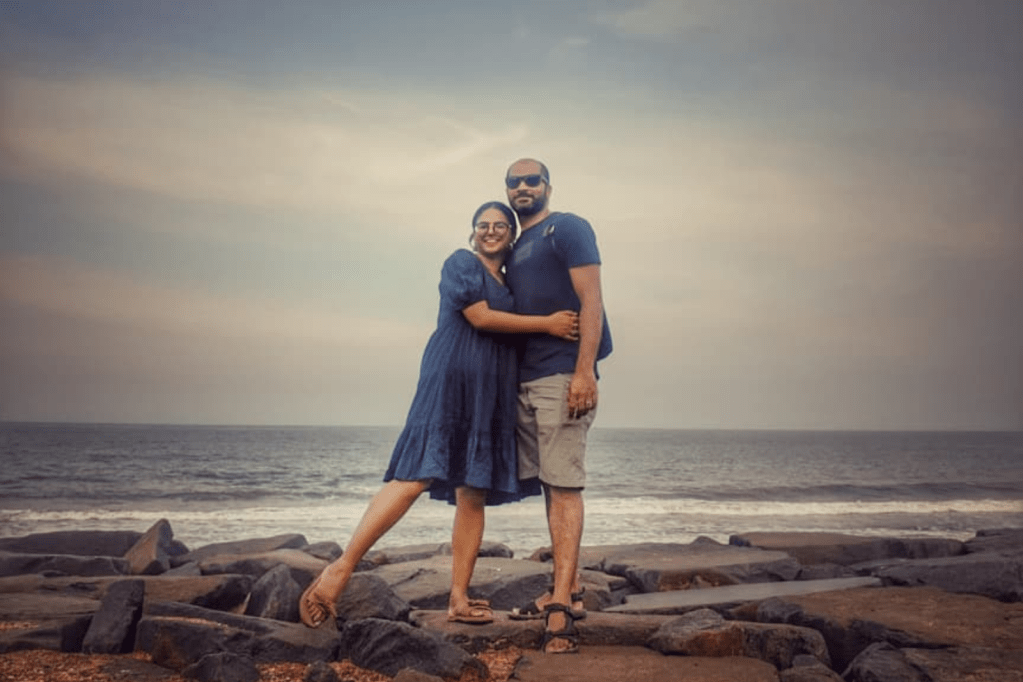
Some trips are meticulously planned. Others, like this one, unfold like a story. One chapter leading to the next, with unexpected flavors, conversations, and memories tucked into every turn. Our bike trip from Bangalore to Pondicherry, and then onward to Chennai, was one of those journeys. We are so excited to share this with you. And, if you’re planning a Pondicherry 2-day itinerary with a Chennai detour, here’s how our days unfolded.
This wasn’t just about ticking off places to see in Pondicherry or making a “one day in Chennai” guide. It was about slowing down, and exploring corners of history.
We happily savored every meal, every walk, every conversation that turned into a memory.
So, without wasting any time, let’s devour and break down our itinerary beyond the guidebooks!
Day 1 in Pondicherry: White Town, Cafés & French Charm
We reached Pondicherry around noon, weaving through the pastel streets of White Town. The first stop was our Airbnb (Ofcourse)!
We stayed at Aurodhan. A beautiful art gallery turned homestay, tucked away in a colonial-style building. You have to consider it the next time you plan a Pondicherry trip!

After we were done praising and clicking pictures of the property, hunger washed us down pretty soon. So, we quickly freshened up, and headed out for lunch.
We discovered a charming French café, 1 Rue Suffren. It was like a vintage building, hosting tables and good food. The smell of butter and coffee filled the air and hearts.
We quickly ordered some grilled chicken and fried crispy lamb with chilled beer. Oh how hungry were we!

The food was really good and pumped us up with energy to dive into our offbeat Pondicherry itinerary.
Let’s start, shall we?
Walking through White Town
What we felt is that White Town is best experienced on foot.
The narrow lanes, the pastel walls, and the way sunlight filters through tall trees. These don’t quite reveal themselves if you’re whizzing past on a bike. So, we parked ours and let the streets set the pace for us.
The first thing that struck us was the color palette of the French quarters.

The mustard-yellow facades with white-framed windows, the pale blue shutters, and the occasional splash of bougainvillea spilling over a gate.
As we walked deeper, I realized why people often call White Town a living museum.
Every corner felt like it belonged in an art postcard. Frozen in time yet alive with the warmth of everyday life.
- Cafés tucked into colonial villas invited us in with the smell of roasted coffee beans;
- Small art galleries peeped from behind shaded courtyards;
- And at each turn, history and present-day life seemed to hold hands.
How enchanting!
The French Institute of Pondicherry

The French Institute of Pondicherry (Institut Français de Pondichéry) is not just another colonial-era building. Did you know that it’s one of the most important research institutes outside France?
Fun facts:
- The institute was established in 1955.
- It began as a center for Indology, focusing on South Indian history, culture, and religion.
- Over time, it evolved into a hub for multidisciplinary studies. Ranging from ecology and botany to social sciences and manuscript preservation.
How cool is that?
What fascinated me most was how this place continues to be a living bridge between France and India.
Inside its archives are more than 8,000 palm-leaf manuscripts, many of them centuries old. These scripts hold topics from Shaivism and Vedanta philosophy to ancient Tamil literature.
The texts are digitized and preserved, making the institute one of the largest repositories of Indological material in the world.
I couldn’t help but think about the scholars who had once traveled across continents to sit here. Working together, welding the fragments of South India’s spiritual and cultural history!
To the casual visitor, the French Institute is a spot for aesthetic pictures. But if you pause to look closer, you realize it signifies something deeper: A collaboration across borders, centuries, and disciplines.
Next, we popped into the Romain Rolland Library.
The Romain Rolland Library

The Romain Rolland Library is one of those places that doesn’t shout for attention. It quietly pulls you in with its old-world charm.
Fun facts:
- It was set up in 1827
- Named after Romain Rolland, the French Nobel laureate, writer, and philosopher (also a close friend of Mahatma Gandhi)
- Happens to be among the oldest libraries in India
- Serves as a public library for the people of Pondicherry.
The library is more than just a collection of books.
It symbolizes the intellectual camaraderie between India and France. Two cultures that shared not just trade routes but also ideas of freedom, philosophy, and art.
Inside, the atmosphere is almost meditative.
Wooden shelves stretch to the ceiling, carrying over 400,000 books, newspapers, and periodicals. The language transcends across English, French, and Tamil. What we loved most was imagining the generations of students, writers, and dreamers who must have sat here.
For a city often linked with cafés and beaches, stepping into this library is like entering another world altogether.
Quiet, scholarly, and timeless.
The Pondicherry Museum

Let me draw an analogy here.
White Town is where Pondicherry wears its French past on its sleeve. And, the Pondicherry Museum is where you truly understand the city’s many layers of history.
Located in a former French colonial mansion, the museum is deceptively small. But its collection is surprisingly vast and diverse. Here are some interesting details:
- One of the most striking sections is dedicated to Arikamedu. The ancient Roman trading port located just a few kilometers south of Pondicherry.
Excavations there revealed Roman pottery, amphorae, beads, and coins. A proof that this sleepy coastal town was once part of a bustling trade network connecting India to the Mediterranean.
- The museum also has an impressive collection of Chola bronzes. Those exquisite sculptures that show the artistic peak of Tamil Nadu’s Chola dynasty.
Each figure,(Shiva as Nataraja or Parvati) radiated both spiritual depth and artistic mastery.
- Beyond these, there are galleries filled with French-era furniture, colonial coins, and archaeological relics from across South India.
Every room felt like a different chapter in Pondicherry’s story. From Tamil dynasties to Roman traders, from French colonizers to Indian independence.
In a nutshell, Pondicherry isn’t just a French seaside town. It’s a palimpsest of civilizations, and the museum makes that layered history tangible.
Evening by the Rock Beach

As the sun dipped, we made our way to the Rock Beach.
There’s something timeless about sitting on the Promenade, watching the waves crash against black boulders. Families strolled, kids ran with balloons, and vendors sold roasted peanuts wrapped in paper cones.
We just sat there, letting the sea breeze undo the tiredness of travel.
Dinner at Sola

We chose Sola as our dinner spot. Sitting by the beach for hours made us crave some pizza. I know there’s no connection, but that’s how it felt!
We knew we deserved a place that has a reputation for serving the best pizzas and cocktails in Pondicherry. Thin crusts, smoky toppings, and drinks that balanced perfectly.
It was the kind of meal that lingers in memory. We ate like there’s no tomorrow and glided back to our Airbnb.
Also, here’s a fun fact – We invented a travel ritual for ourselves. Exploring movies and documentaries shot at our travel destinations. So we curled up in bed to do so.
Soon, sleep came by.
Day 2 in Pondicherry: History, Artisans & Auroville
The day began with a promise of food and stories. We rode past the city. Letting the gushing air embrace us, as we jumped into our adventures for the day.
Breakfast at Bread & Chocolate

Our morning began at Bread & Chocolate.
A café famous for its sourdough, smoothie bowls, and (of course) chocolate. It buzzed with travelers, digital nomads, and locals alike, but the food made it worth the wait.
Ahh, I can still smell the hot chocolate on bread after weeks!
A Brush with History at Netaji Memorial Bookshop

From there, we rode to the Netaji Subhas Chandra Bose Memorial Museum and Bookshop. A quiet yet powerful space.
Standing in front of Netaji’s memorabilia (books, letters, even photos), you can sense the history. Pondicherry was once a hub for freedom fighters in exile.
Goosebumps!
Meeting Artisans at the Art and Craft Village
Next, we started with a short ride from White Town and landed at the Art and Craft Village.

It is a space that feels less like a tourist stop and more like a living museum.
Scattered across the grounds are mud huts and workshops. Here artisans practice crafts passed down through generations.
- pottery,
- weaving,
- wood carving,
- palm-leaf work.
The air carried a sense of slowness, as if time bent itself to the rhythm of handmade art.
Here, we had the opportunity to meet an artisan (Siva Perumal). He shapes handmade paper into decorative items with practiced ease.

What started as a brief interaction soon evolved into a long conversation. We discussed craft and livelihood. He told us how every piece held a story, an inheritance of skill and patience.
A humble plea: Kindly check out his work and feel free to order items via his Instagram page.
In that quiet space, surrounded by clay and earth, we realized the village was so much about sustaining identity.
It became one of the most grounding experiences of our journey.
Boat Ride to Arikamedu

Time passed quickly and soon we were basking in the hot afternoon sun. Waiting for an adventurous boat ride to Arikamedu.
It was supposed to be a ride through mangrove forests, past fishing harbors, and finally to Arikamedu.
Fun fact: Arikamedu was once a bustling port where Roman and Tamil traders exchanged beads, wine, and textiles.
Today Arikamedu is quiet, in ruins, moss-covered bricks, and engulfed by the sound of the river. To stand there is to realize how global Pondicherry was long before “globalization” became a word.
Auroville: A Different World

As we all know, no Pondicherry itinerary is complete without Auroville. For us, Auroville wasn’t just a tourist stop.It carried a personal connection.
Years ago, Ayush and I had first read about the Matrimandir. A golden globe at the heart of the community, symbolizing unity and inner peace. Ever since, it has been on our list.
Fun facts:
- Auroville was founded in 1968 by Mirra Alfassa (The Mother), a spiritual collaborator of Sri Aurobindo.
- It was meant to be a place “where men and women of all countries live in peace and progressive harmony, above all creeds, politics and nationalities.”
- Its philosophy is rooted in collective human unity, inner growth, and sustainable living.
- Even today, Auroville’s communities experiment with organic farming, renewable energy, and alternative education.
We slowed our pace, sat by the gardens, and let the stillness sink in. Auroville has that effect. It asks you not to rush, to simply be.
However, walking deeper into it, I started developing conflicting feelings. Here’s how:
Auroville speaks of transcending money. Yet much of its visitor-facing side thrives on boutiques, cafés, and curated workshops. Of course they are priced steeply.
The paradox was striking: a place built on detachment and simplicity, surviving on tourism-driven consumption.
Still, maybe that’s the nature of ideals in practice.
They bend, adapt, and sometimes contradict themselves. Perhaps Auroville isn’t about answers at all. It’s a mirror, reflecting back our hopes, doubts, and contradictions.
Whatever, worth a visit.
Evening stroll on Serenity Beach
We wrapped up our Auroville visit and grabbed a quick Asian lunch at The Koi. It is an Asian café serving ramen bowls and sushi that hit the spot after a long ride.

Later, we drove to Serenity Beach, where surfers danced with waves and the horizon stretched endlessly. We basked in the sea breeze for a while and as dusk fell, we returned to White Town.
Strolling through the streets, we halted at the popular Coromandel Café for dinner. It is another gem where French-Indian fusion met a cozy courtyard setting. Really, what a perfect day!
Soon, we were back to our Airbnb. Bags were packed. The next morning, Chennai awaited.
Day 3: Spending 24hours in Chennai
Leaving Pondicherry, the ride to Chennai was a treat in itself.

The East Coast Road unfolded like a painter’s canvas. Palm trees swaying, glimpses of the sea, fishermen mending nets, and stretches of green paddy fields.
It’s one of those roads where the journey is as rewarding as the destination.
Settling In
We checked into our Chennai Airbnb, freshened up and ordered a hearty Andhra Biryani. After resting for a while, we put back our riding gears on. We only had 24 hours, we can’t possibly miss a minute, you see!
Bike Ride Through Chennai
We spent the afternoon exploring Chennai riding through the massive city.
Our first stop was Marina Beach.
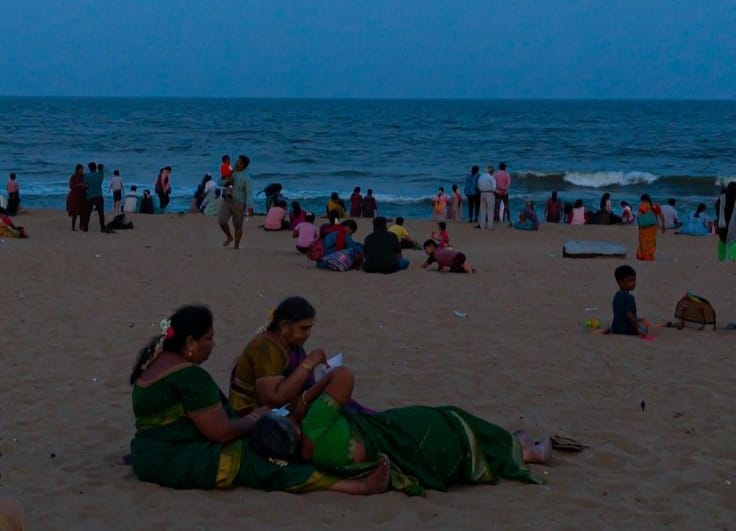
What a vast and endless beach! The best part was how it was buzzing with life even after the rough patch of rain. We sat and enjoyed the sea breeze while gorging on cornettos. Ah, cheers to the dreams of childhood!
Anyway, as we were short on time, we decided to explore the city on bike, without stopping anywhere.
So we drove past the,
- colonial-era government buildings,
- the M. A. Chidambaram Stadium,
- and finally into the old quarters where Ayush had once lived when he began his career in the city.
It felt nostalgic. Revisiting streets he once knew, pointing out old eateries, recalling stories from his early days.
I couldn’t get enough of this ride!
Rain-Soaked Evenings
What happened next was beyond my wildest expectations! The skies opened up just as we were riding.
Rain in Chennai has its own rhythm. Heavy, warm, cleansing. Instead of hurrying back, we embraced it, letting the downpour soak us as the city glittered under streetlights. Tell me, wouldn’t you love this?
We stopped by a local favorite eatery (as instructed by our Airbnb host). Instantly, we devoured some spicy curries, fresh parottas, and sweet payasam and wrapped up the tour for the day.
Back at our hotel, we ended the day watching Life of Pi. A fitting choice, considering parts of it were filmed in Pondicherry. Oh yes, we can be filmy in our own ways, haha!
Soon we dozed off, drenched in exhaustion and content, with the sound of rain tapping the windows.
Reflections on 3 Days by the Coast
Looking back, what made this trip special wasn’t just the things we did in Pondicherry or in Chennai.
It was made up of the little things.
- The artisan’s words at the craft village,
- the taste of fresh sourdough at Bread & Chocolate,
- the quiet ruins of Arikamedu,
- Ayush pointing out his old office building in Chennai.
All of these, made the trip magical.
And, if you’re planning a similar trip, here’s a quick snapshot of what worked for us:
- Stay in White Town, Pondicherry → for walking access to cafés, museums, and the beach.
- Mix popular spots with hidden gems → Auroville + Arikamedu + local libraries gave us balance.
- Food is part of the itinerary → 1 Rue Suffren, Sola, Bread & Chocolate, Coromandel Café, The Koi—all unmissable.
- Don’t skip Chennai → Even in just one day you can cover Marina Beach or the heritage architectures. And ofcourse, the flavor of a bustling coastal city.
Three days felt both long and short. Long enough to immerse in the rhythm of these coastal towns, short enough to leave us wanting more.
And that’s the best way to travel, isn’t it?


 Invisible Cities
Leave a comment