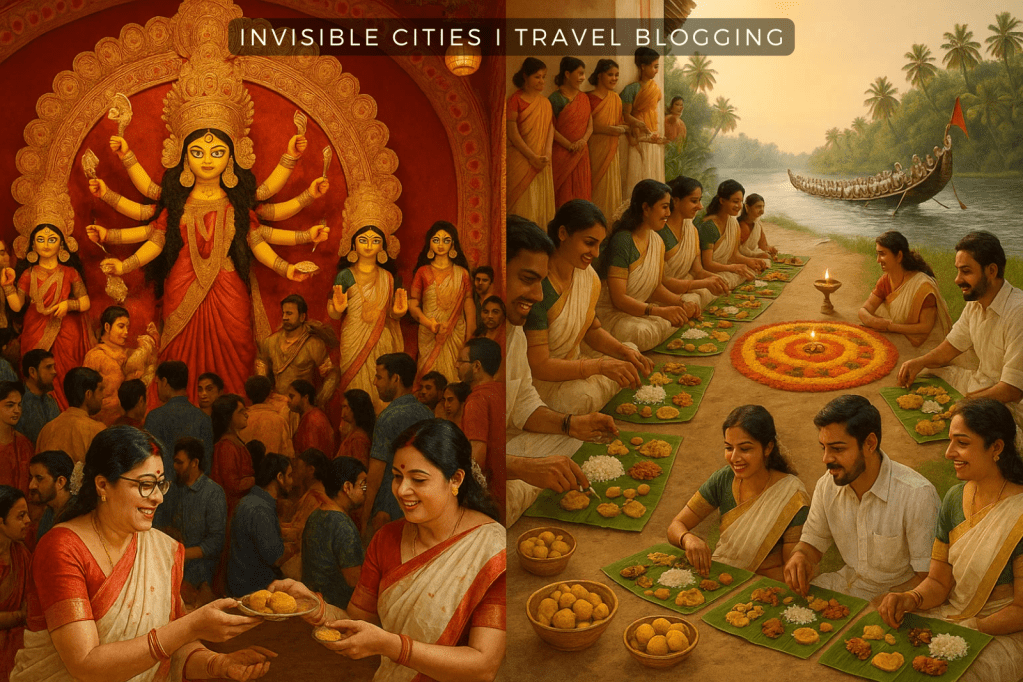
Why am I writing about Onam in Bangalore, being a Bengali? That too on a Travel blog? Well I had to. Because I have traveled places metaphysically through Onam, when I built a home here. Let me explain with my story.
I moved from Kolkata to Bangalore two and a half years ago. That time I thought it was the end of “festivities” for me. Growing up as a Bengali in Kolkata, festivals majorly always equaled Durga Pujo. Five days of pandal hopping, bhog khichuri with labra, the sound of dhaak, and that delicious anticipation of bijoya mishti.
Honestly, I have been an atheist since the time I developed reasoning abilities. Still, I could never NOT get excited about Durga Pujo. And please! Festivals are culture any way! How can I leave culture behind, right?
But then September rolled around, and I was suddenly introduced to something new: Onam in Bangalore.
At first, it was just a curious buzz in the air.
My Malayali colleagues started talking about Sadhya as if it was some secret grand feast. Apartment noticeboards had announcements about cultural feasts and “Pookalam competitions.” I was so confused. Also, I was too homesick to give in to this, and put effort into researching.
Yet, one fine morning, I walked into my office lobby to find the floor voraciously decorated. There was this giant circle of marigolds, chrysanthemums, and rose petals. Bright enough to outshine even a Durga Pujo pandal light. Trust me!
But there was more to it.
On the way to office, I found people dressed in gorgeous shades of white and golden. You have to see the cute gajras that the women wear on their hair on every event.
Too warm and pretty to get over!
And, that… was my first proper brush with Onam in Bangalore.
Over the next few years, I realized it has far more in common with Durga Pujo. This was more than I ever imagined.
Let me tell you how and why!
What is Onam, anyway?
Onam, I learned, is all about welcoming King Mahabali. He was a wise and generous ruler of Kerala. He is believed to visit the state once a year to see his people. According to mythology, it is a boon granted to him by Lord Vishnu). Cute story, I know!
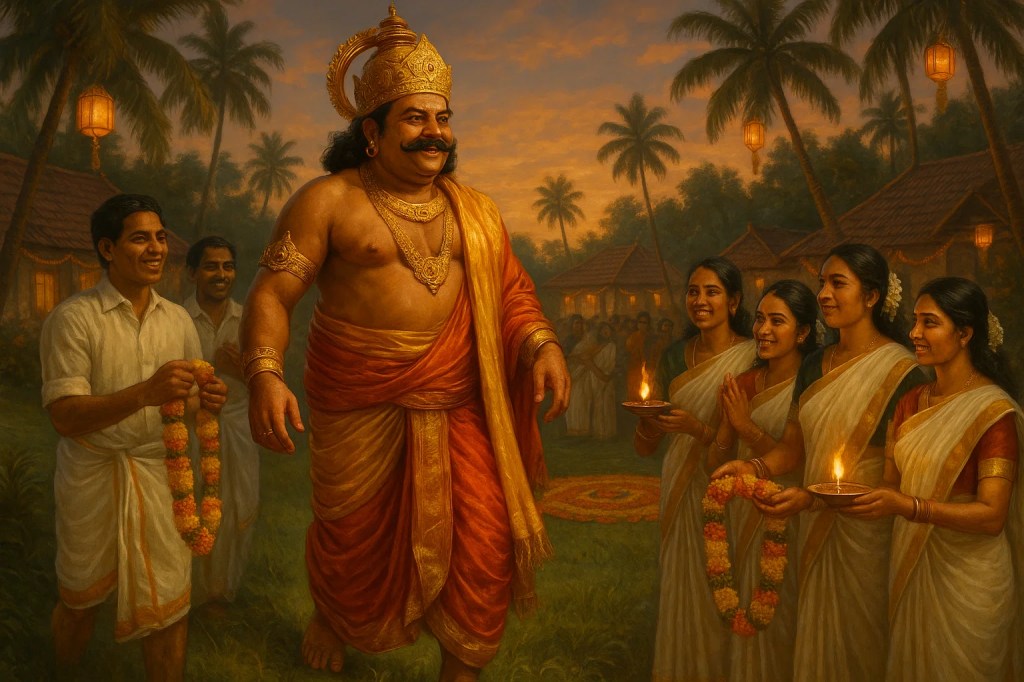
But that instantly reminded me of Durga maa, visiting her home, once a year during Navratri. That’s how the stories bear relevance and analogy, you see?
Both festivals celebrate this sense of return, reunion, and nostalgia.
In Kerala, people wait for Mahabali like an old friend; in Bengal, we wait for Durga like a beloved daughter.
Sitting in my Bangalore apartment, far away from home, I found that idea comforting.
From Rosogolla to Payasam: My First Onam Sadhya
Now let’s talk food, because honestly, that’s where Onam really wins hearts (atleast my heart)!
My very first Onam Sadhya in Bangalore was at a small Malayali restaurant in HSR Layout. Probably, Kottayam.
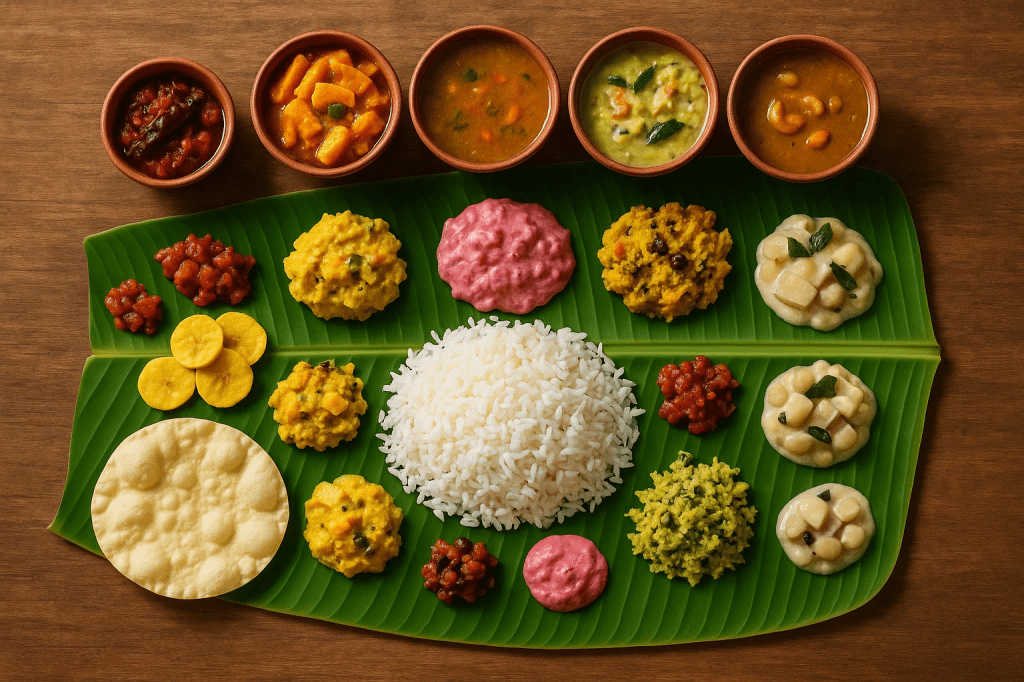
There, I sat down in front of a banana leaf. I clearly remember feeling nervous because everyone around me seemed to know exactly what to do.
But I didn’t have to sit idle for long!
Within minutes, servers started dropping spoonfuls of curries, chutneys, and vegetables onto my leaf. Avial, olan, thoran, pachadi… words that sounded musical but mysterious.
The only rule, apparently, was to not ask for a spoon.
So there I was, a Bengali who grew up eating mishti doi and luchi with my hands. Suddenly feeling like a complete novice.
Should I start from the top left of the leaf? Should I mix the dal with rice or keep it separate? By the time the second round came, with payasam served in a tiny cup, I was both stuffed and delighted.
Later, I compared notes with my Malayali friends. I realized that the Onam Sadhya in Bangalore can be just as authentic as one in Kerala. How satisfying!
26 dishes, all vegetarian, each with its own place and purpose.
For someone used to fish curry and kosha mangsho (mutton curry) as festive staples, this was a surprising change.
You get me, don’t you?
Durga Pujo and Onam: Same Emotions, Different Languages

The more I experienced Onam, the more I noticed the parallels:
- Food at the center: Sadhya in Onam, Bhog and mishti in Pujo.
- Family time: Families travel back to Kerala for Onam, just like Bengalis return home for Pujo.
- Mythology and nostalgia: Mahabali visiting his people; Durga visiting her parents.
- Community over individual: Both festivals are less about personal rituals and more about collective celebration.
But you know what? One of my favorite parts of Onam is the Pookalam. It is the floral rangoli that every household and community builds.
We have a similar thing in Pujos of Bengal. It’s called aalpona. It is a Bengali folk art style rangoli, painted on floors and walls with paints made from rice flour. Sweeeet!
Both are works of art, painstakingly created by volunteers who pour their creativity (and back-breaking labor) into making something magical.
In Durga Pujo, the artistry is in the pandal and idol decoration. In Onam, it’s in the symmetry of flowers on the ground.
But the spirit is the same.
People dressing up, coming together, and contributing little pieces of themselves to build something beautiful. Totally worth it!
Onam in Bangalore
What struck me most about Onam celebrations in Bangalore is how they adapt.
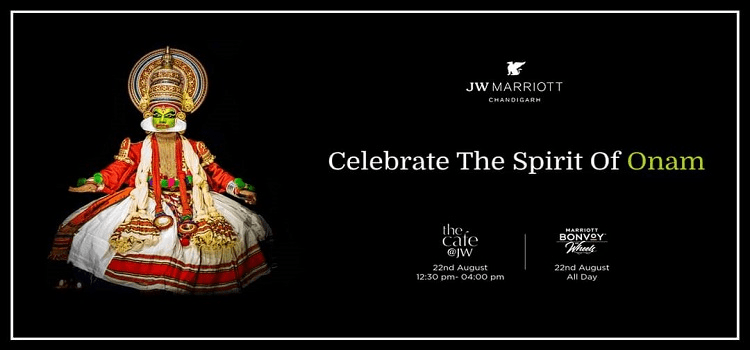
- You’ll find luxury hotels (JW Mariott, Radisson blu, and so on) serving elaborate Sadhyas, complete with chenda melam (drum performances).
- You’ll see Malayali associations in Koramangala hosting cultural programs with thiruvathira dance. Even malls get involved, hosting flower carpet competitions and showcasing folk art.
It reminded me of how Bengalis abroad recreate Durga Pujo in community halls, with makeshift idols and smaller-scale rituals.
The scale may differ, but the sentiment doesn’t. And this, my friend, is culture, not Religion. Festivals don’t need their native soil to thrive.
They just need people who care enough to keep them alive.
What Onam Taught Me as a Bengali in Bangalore…
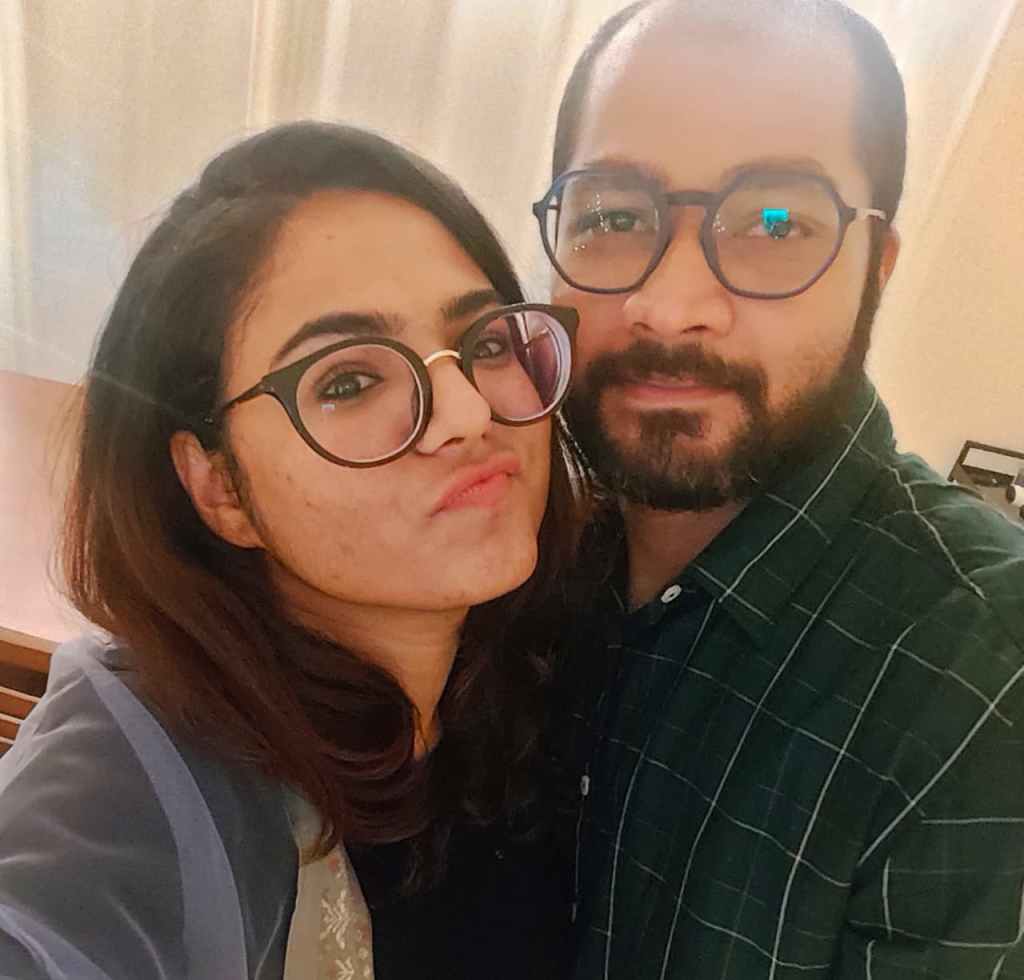
Living in Bangalore has given me the chance to be a part of something that wasn’t originally mine. Firstly, the sense of independence and the strength to cope with everything that doesn’t feel like home.
Everything here now feels oddly close to my heart. Yes, including the festivals. Onam taught me that festivals are less about where you come from, and more about how you come together.
Today, when I see a pookalam blooming in the lobby, I feel included. When I hear about an upcoming Onam Sadhya, I don’t feel like an outsider peeking in. Infact, it was me who urged my friends to try the sadhya this year as well. I hope you understand the pain of eating an all-veg cuisine, being a Bengali!
But it all shapes up.
I feel like I have been warmly invited into another family’s celebrations. Very much like I’d invite a friend from different culture to try out Dada Boudi Biriyani or Ilish macch meals.
Or even to taste bhog khichuri in Kolkata during Durga Pujo.
And maybe that’s the best part of living in a cosmopolitan city like Bangalore.
You don’t just celebrate your own traditions. You get to borrow and blend into others, creating new layers of identity along the way.
So, yes. I’ll always be a Bengali at heart, who waits for the sound of dhaak and the fish platter. But, you’ll also find me sitting in front of a banana leaf here, on every Onam celebration.
Happily rolling payasam around with my fingers in Septembers. Smiling at how beautifully familiar the unfamiliar can feel.
In a Nut shell
So hi there! If you’re a non-Malayali living in the city, don’t miss this chance. Experience the Onam celebration in Bangalore at least once. Promise?
Attend a community event, try the Sadhya, watch a pookalam being made. You might discover, as I did, that Onam isn’t just Kerala’s festival. It’s an experience that welcomes anyone who’s curious enough to join in.
And who knows? You might just find a little bit of your own culture reflected back in it. Just like I did!



 Invisible Cities
Leave a comment