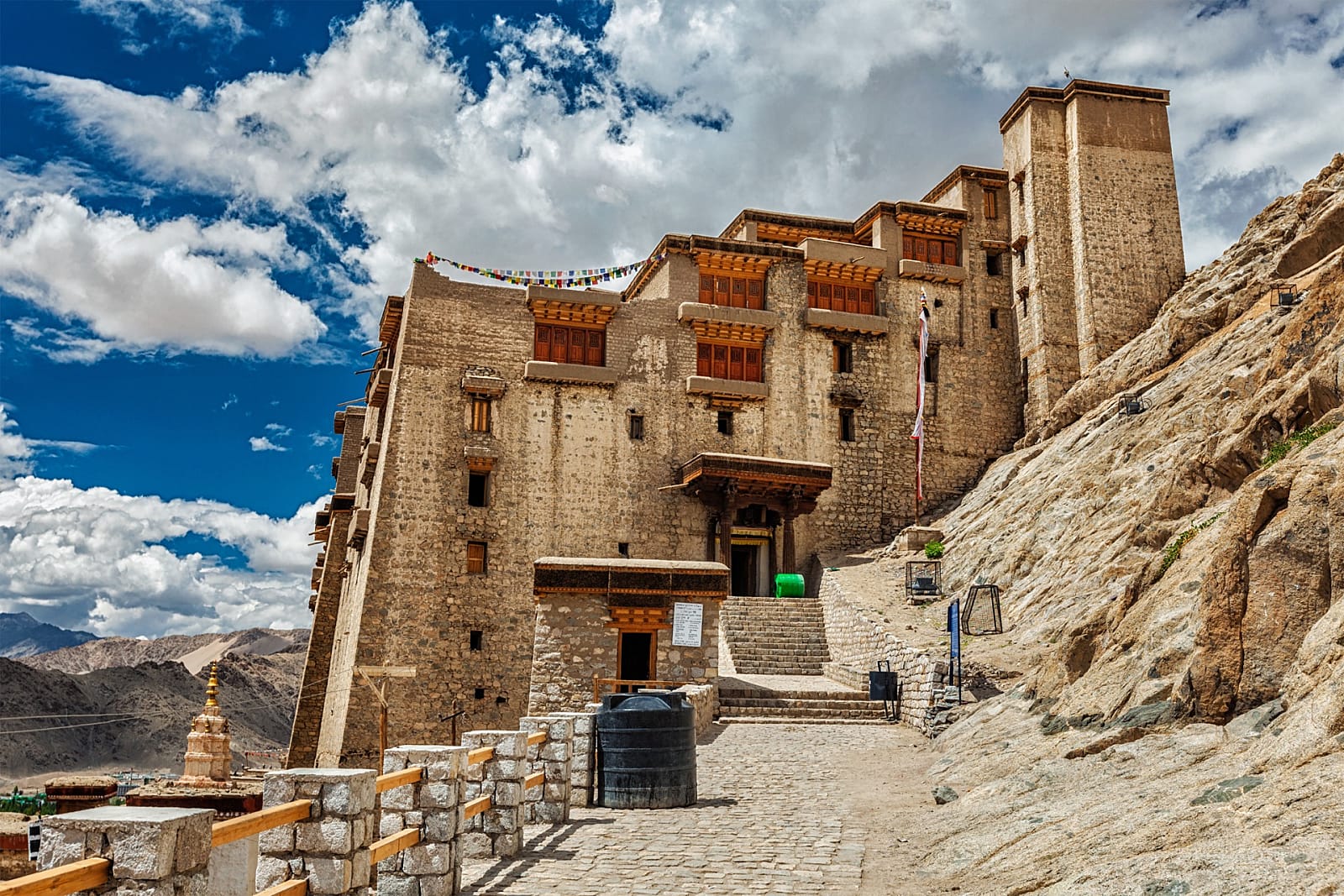
The Leh Palace, seated on top of the Leh town, is often photographed, but rarely understood. For instance, the tourists visit it for the panoramic views, the historians admire its strategic location. But beneath its rugged walls and shattering roof, lie stories that have remained in the shadows since decades. Totally untold, almost undocumented, and mostly unknown.
In this article, we write about the unknown bits of the Leh Palace. An architecture that is more than just a royal ruin and a listed tourist spot.
Here, we are going to highlight its wartime architecture, secret tunnels, Tibetan influences, and the surprising reasons behind its abandonment.
Read on…
The Origins of Leh Palace

The palace was built in the 17th century by King Sengge Namgyal. The royal decor was not just for royalty but for resilience (which you will come across later in the blog).
It stands against the backdrop of the Himalayas. A location and layout that were chosen with both majesty and military strategy in mind.
Unknown Facts about the Leh Palace:
- Leh Palace was built with the idea and possibility of warfare in mind. It was built like a fortress.
Minimal ornamentation, thick walls, and narrow passages allowed better defense during invasions. - The design of each floor had a purpose (basically hierarchy, as we call it):

- Top floors were for the royal family residences.
- Middle levels were for the administrative areas and temples.
- Lower levels served as stables, kitchens, and storage.
- The palace had secret war tunnels (were you ready for this information?)
Built as escape routes, these tunnels connected the palace to:
- The base of the hill.
- Monasteries and storage locations.
- Its 9-storey structure was unmatched at the time.

It was the tallest building in the Himalayas in the 1600s. This made it both a symbolic stature as well as a stronghold.
Leh Palace and the Potala Palace Connection

Most visitors are struck by how much Leh Palace resembles the Potala Palace in Lhasa, Tibet. But his isn’t a coincidence. It’s a symbol of shared political and religious ideology.
Lesser-Known Details about the two palaces:
- Both were built around the same time.
Potala Palace: 1645
Leh Palace: Early 1640s - There was intentional cultural alignment.
Artisans from Ladakh are believed to have worked on Potala Palace. In doing so, they brought back techniques and ideas to build the Leh Palace. - Architecture mirrored spiritual alliances.
Both palaces featured:
- Central temples.
- Multi-tiered courtyards.
- Orientation towards sunrise for spiritual rituals.
- Leh Palace was meant to be Ladakh’s Lhasa.
The similarities were a political message: Ladakh was spiritually aligned with Tibet, not the Mughals or Dogras.
How convenient, ha?
Why Was the Leh Palace Abandoned?
This is perhaps the least addressed aspect of Leh Palace. While most visitors assume it simply “fell out of use,” the truth is more complex. Here’s what we found out!
Historical Abandonment:
- Captured by Dogra forces in 1842.

After their invasion, the Namgyal royal family fled to Stok Palace, which became their new seat of power.
- The palace was never reused.
Unlike other conquered forts, Leh Palace wasn’t converted or rebuilt, it was simply left to decay.
Modern Abandonment (Post-Independence):
- Restoration efforts were started, but were soon halted.
The Archaeological Survey of India (ASI) began renovation in the 1980s. However:
- Lack of funds slowed work.
- Local resistance emerged, fearing loss of spiritual sanctity.
- Structural fragility made further work risky.
- Some upper floors are still sealed.
The top levels remain unsafe and closed to visitors. Renovation was paused indefinitely in the mid-2010s. - Plans for a museum were shelved.
Despite efforts to turn the palace into a heritage center, the project was quietly abandoned.
Hidden Features of the Leh Palace
Beyond the few publicly accessible galleries, Leh Palace hides a number of architectural secrets. These are rarely included in guidebooks or tours. For example,
- Concealed prayer chambers.

Small, windowless rooms behind wooden panels were used for private Buddhist rituals. Some of these chambers are aligned to catch the first light of dawn. Serene, isn’t it?
- A passive air circulation system.
Tiny wall vents regulate airflow naturally, keeping interiors cool during summer and reducing oil-lamp smoke indoors. - Rooftop rainwater collection basins.
Ingeniously designed to harvest limited rainfall and channel it into tanks for use during dry months. - Royal kitchens with spice residue.
Recent analysis found traces of turmeric and cardamom. These luxury spices are said to have been imported through Kashmir.
Forgotten Faces Behind the Leh Palace
While most stories focus on kings and monks, there’s a bit more here. The Leh Palace was also shaped by everyday people, like artisans, scribes, and women of the court.
Check out the highlights here:
Overlooked Contributions:
- Artisans from Nubra and Zanskar.
Known for blending Tibetan and Kashmiri masonry, they built the palace without modern tools. - Women’s quarters were uniquely positioned.
Located on the topmost floors, these rooms offered privacy, meditation spaces, and weaving areas. - Royal scribes documented everything.
Manuscripts found in Tibetan and Balti mention:
- Trade agreements.
- Religious donations.
- Palace expenses and daily life.
What You Can Still See Today…
Despite the palace being in ruins at present, the Leh Palace continues to offer visitors glimpses into Ladakh’s royal past.
Must-See Highlights of the Leh Palace:
- Panoramic view from the terrace.

Overlooks old Leh town, the Stok range, and the Zanskar mountains.
- ASI photographic exhibits.
Archival images show Leh Palace before tourism and development changed the town’s face. - Faded murals and Thangka art.
Though weathered, some inner walls still carry traces of 17th-century Buddhist art.
- Smoothened stone thresholds.

Generations of footsteps have worn down these stones. It is also a proof of the life this structure once held.
Final Thoughts
Leh Palace is more than an abandoned monument. It is a historical interface between Tibet and Ladakh, war and peace, grandeur and survival.
So, the next time you’re in Ladakh, take a slow walk through Leh Palace.
Look beyond the broken walls, and seek out the silence behind the architecture. In doing so, you might just uncover a royal legacy that history books rarely mention.




Leave a Reply